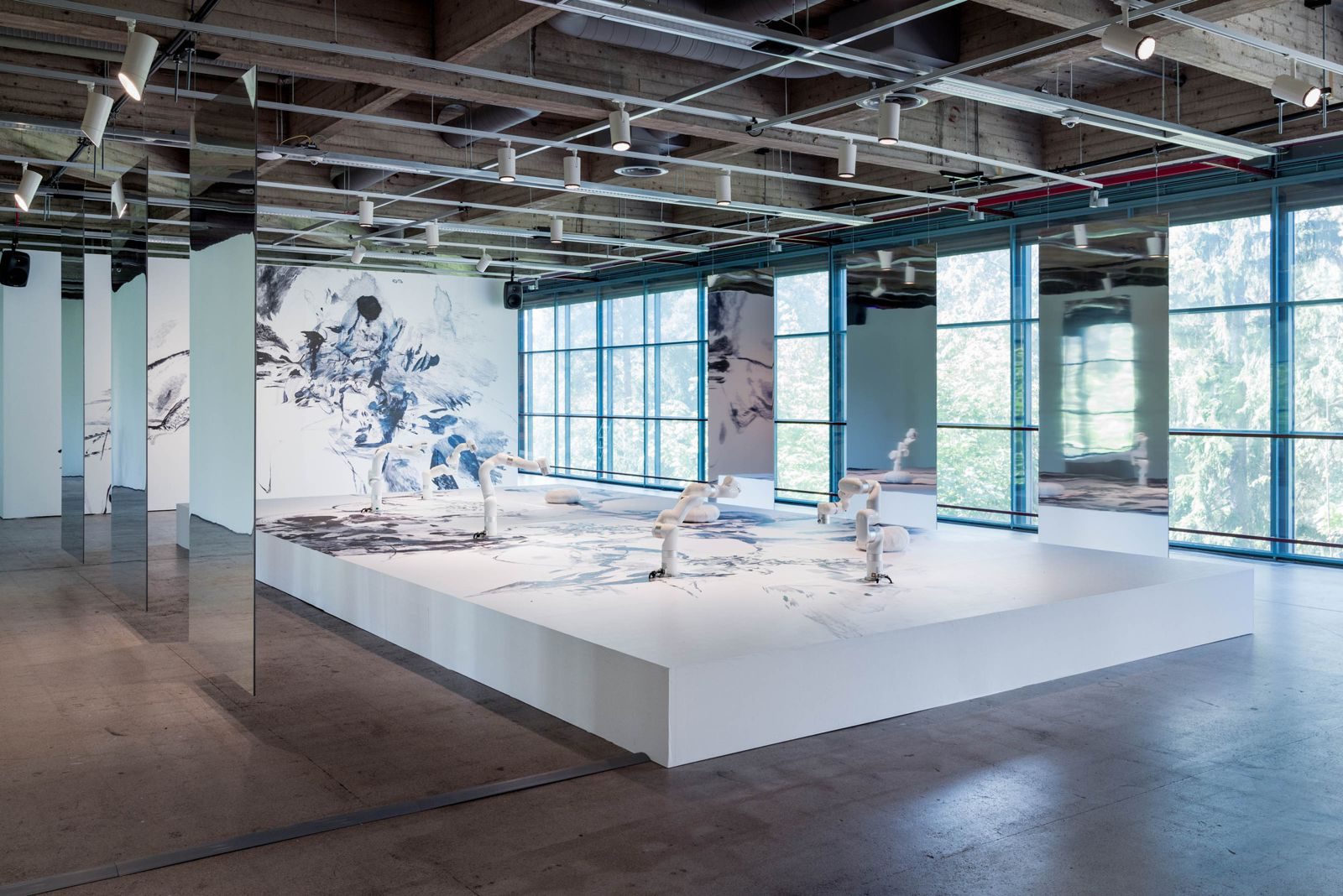
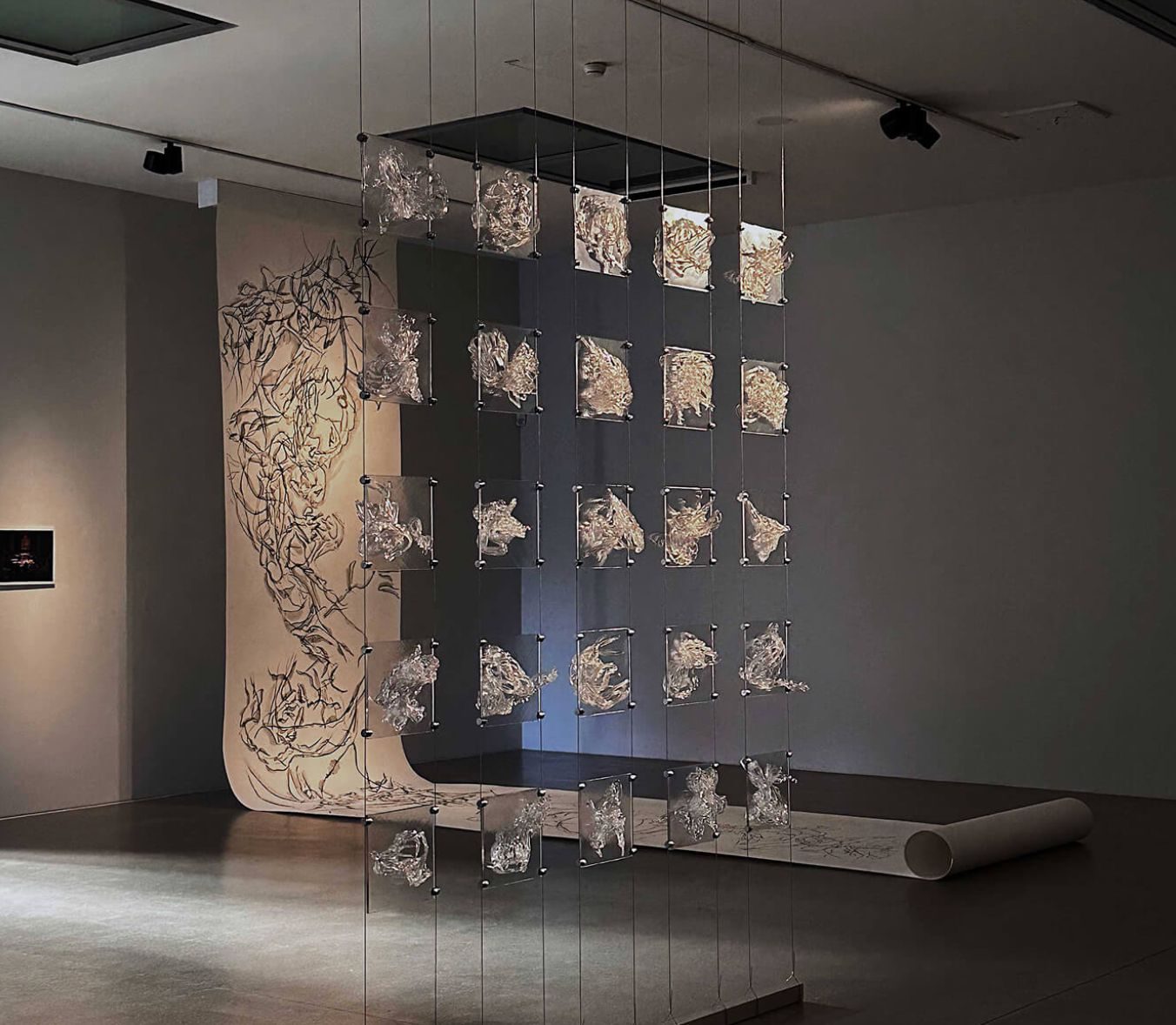
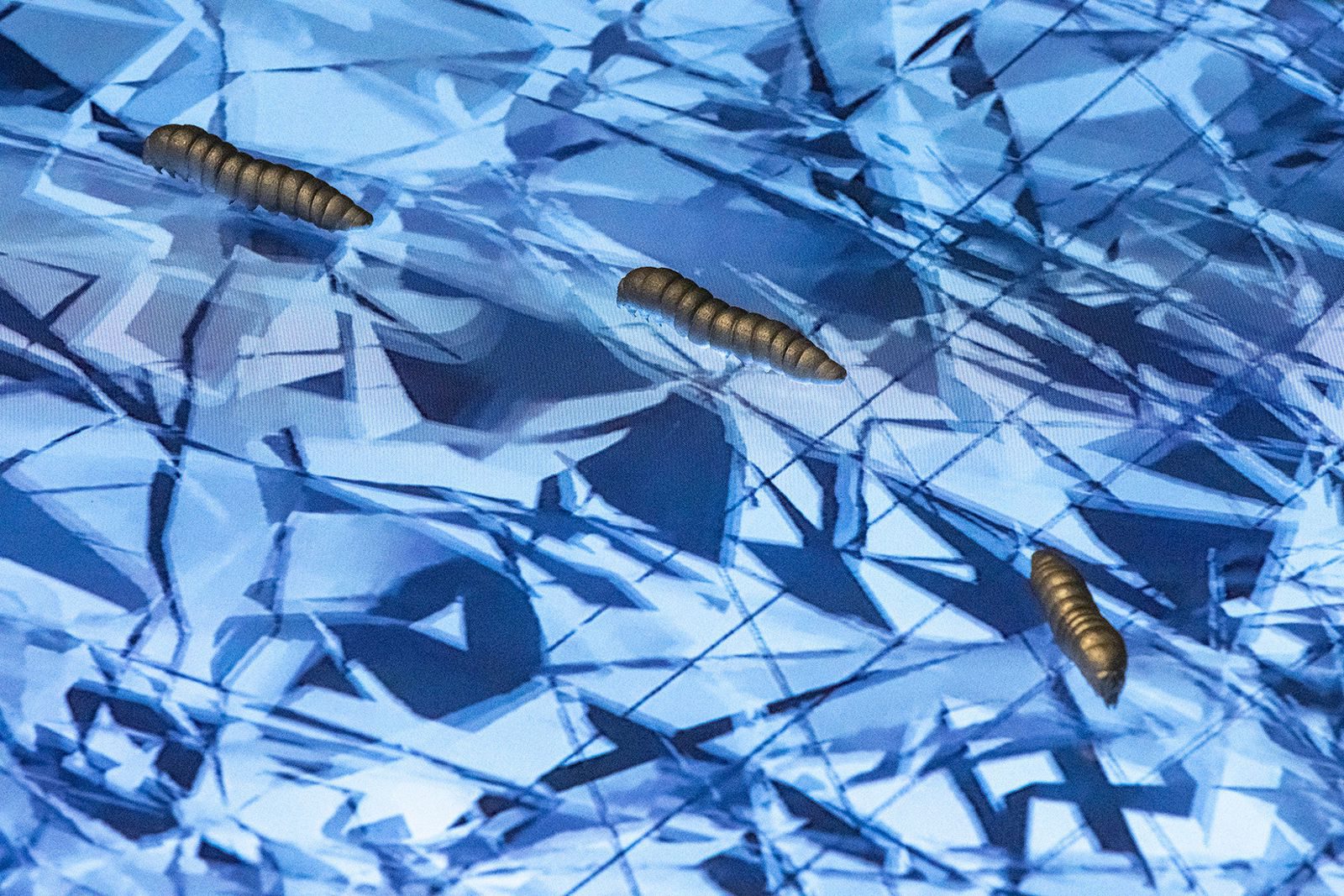
RECURSIONS 遞迴 is a monumental scroll and accompanying digital work by Sougwen 愫君 Chung, made through a collaborative drawing practice with a robotic system developed over more than a decade.
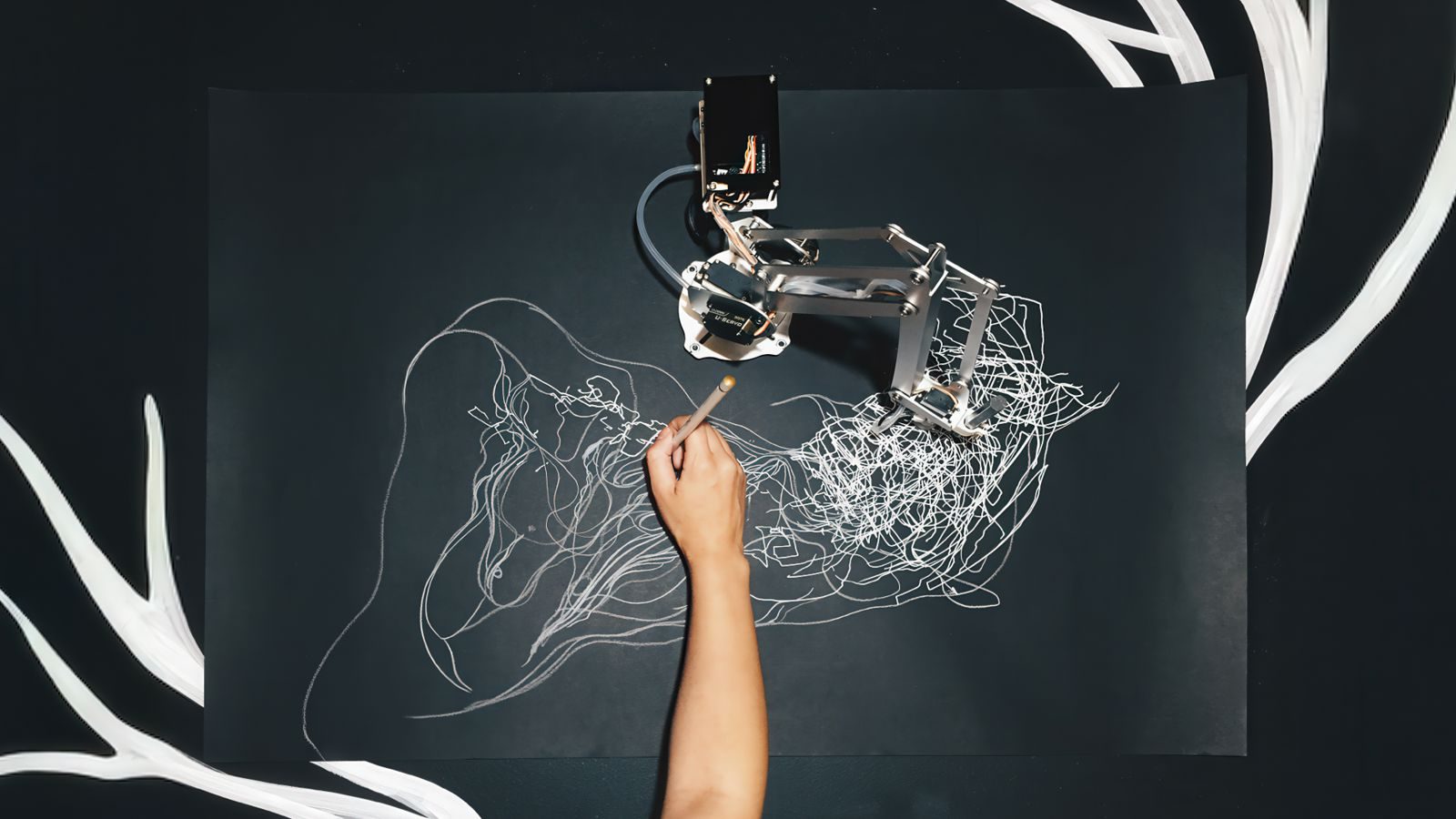
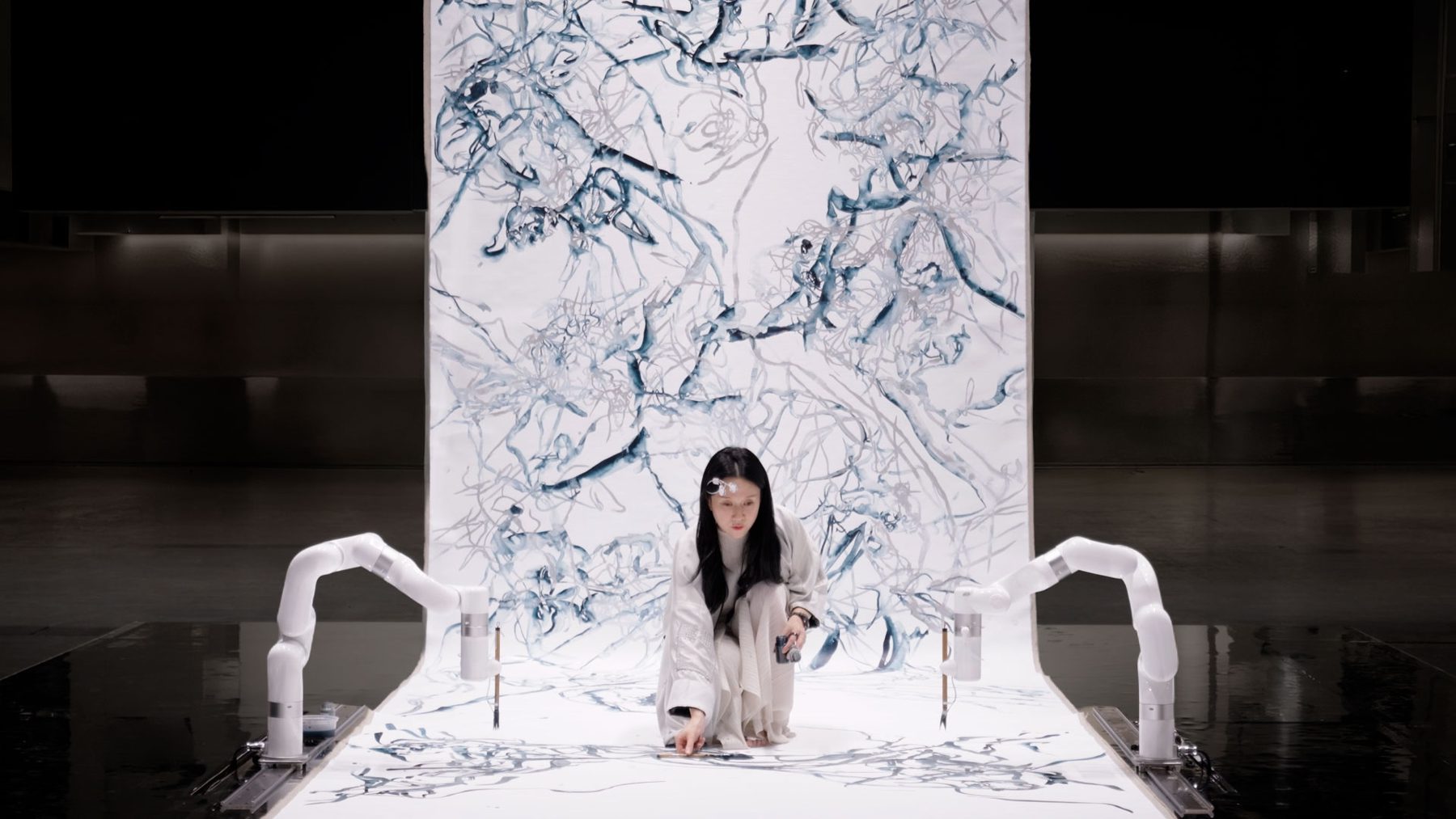
The artist paints with two robotic arms linked to their body through live EEG brainwave data, using two chemically incompatible ink systems: a water-based calligraphic ink that bonds with the linen, and a conductive silver composite that sits on the surface, catching and releasing light.
The word recursion (遞迴, dìhuí) means to pass forward in sequence and to circle back through movement. In the work, this structure is both computational and genealogical.
遞迴 (dìhuí), the Chinese term for recursion, means to pass forward in sequence and to circle back through movement. In Sougwen Chung's RECURSIONS, this logic operates simultaneously across computation, material, body, and lineage.
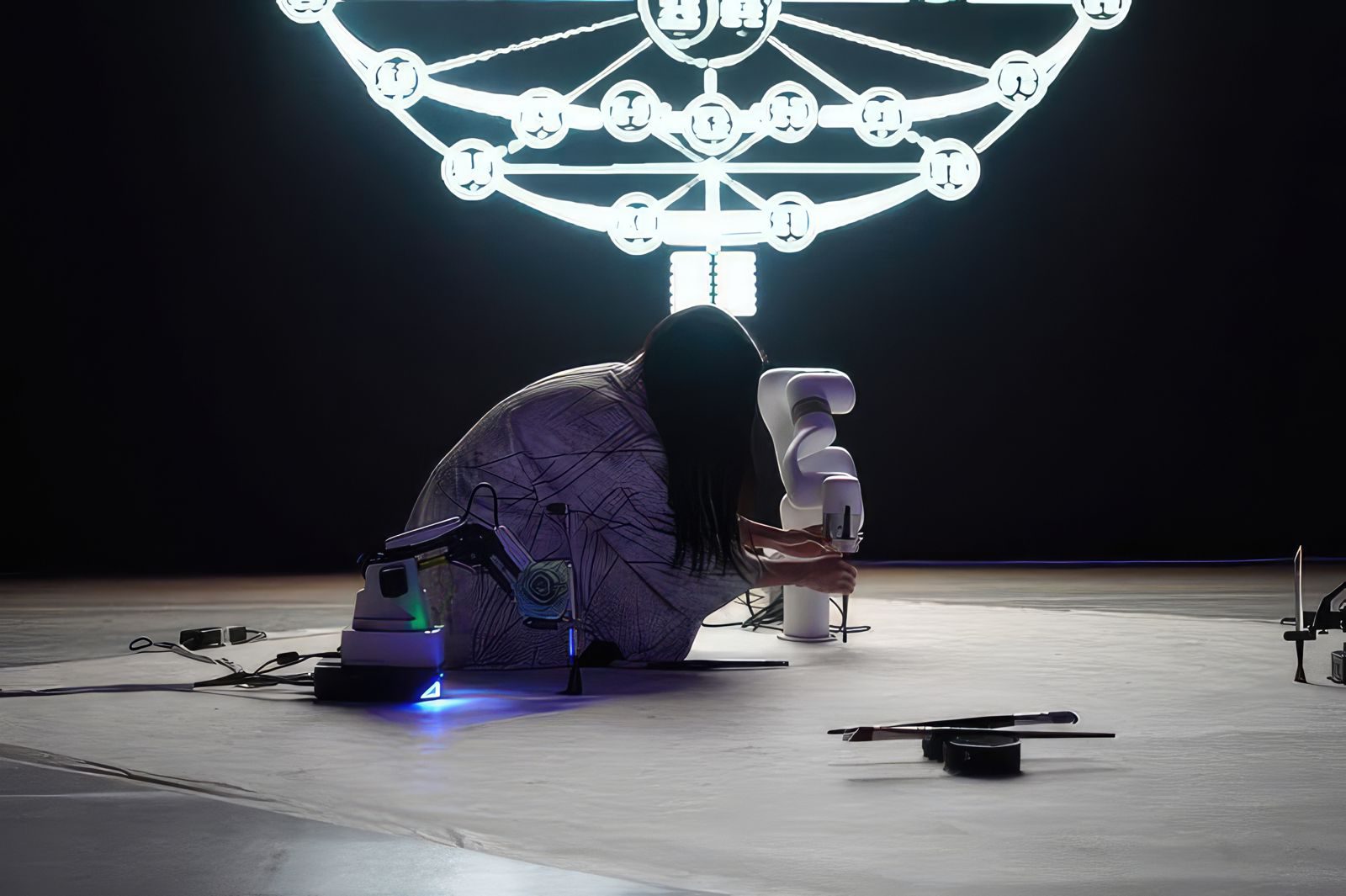
The artist paints alongside two robotic arms on a monumental linen scroll. The robotic system draws from a neural network trained on decades of the artist's archived gesture and calligraphic data, as well as on artefacts produced across ten years of human-machine co-aesthetics. As the artist paints, a custom EEG sensor captures live brainwave activity; different waves modulate the model's gestural response, creating a recursive loop in which past gestures generate new trajectories to which the artist responds.
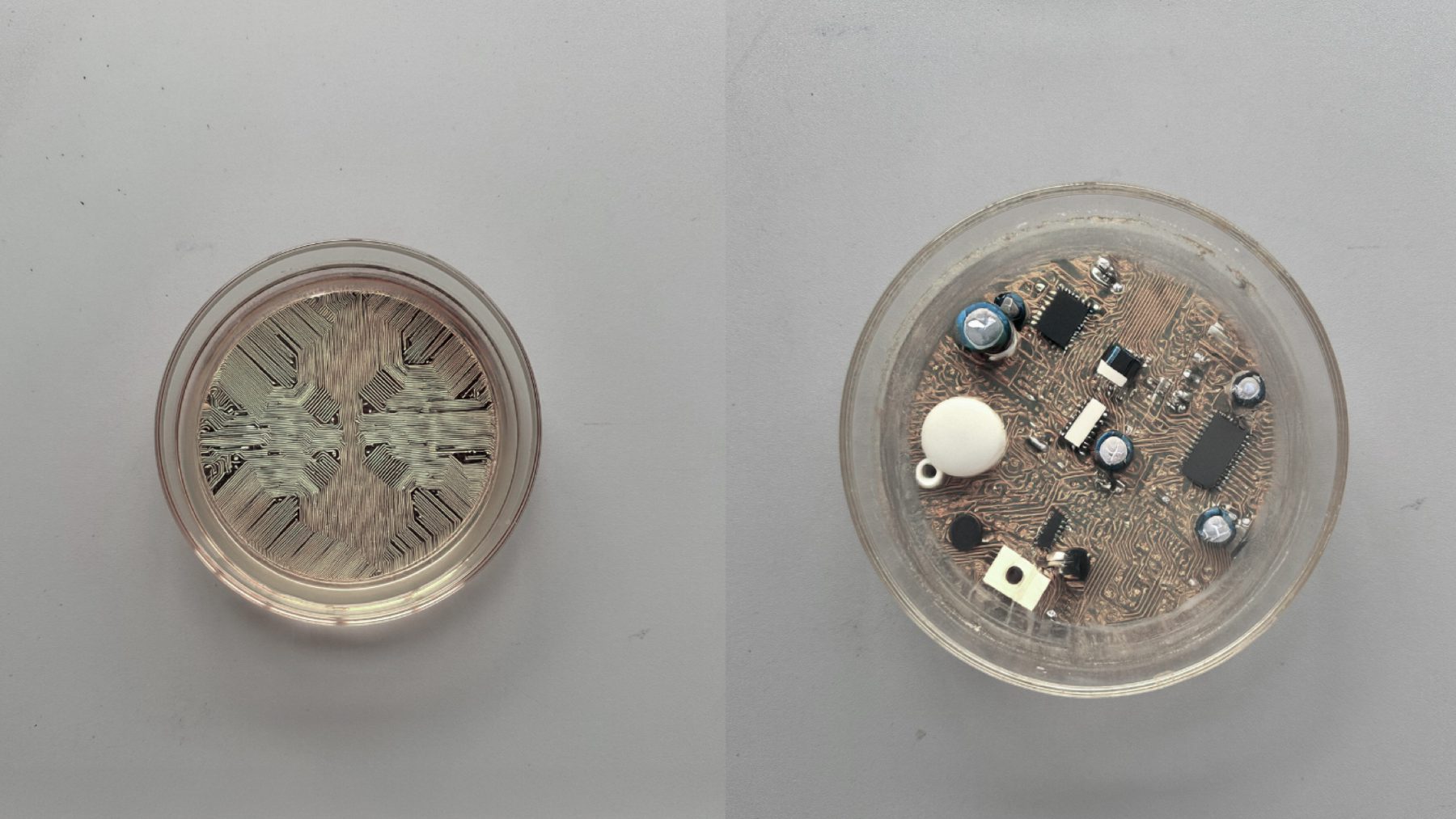
The scroll is made with two chemically incompatible ink systems. A water-based calligraphic ink sinks into primed linen, bonding with the weave. A custom composite of 99.99% pure silver flake in shellac-based bioresin with silk fibroin protein sits on the surface, reflecting light directionally. Where the two inks meet, the silver pushes the water away, creating moments of separation within a single stroke. At its highest concentration, the silver composite has conductive properties; as the inks commingle, this conductivity erodes. A current that dissipates at the threshold.
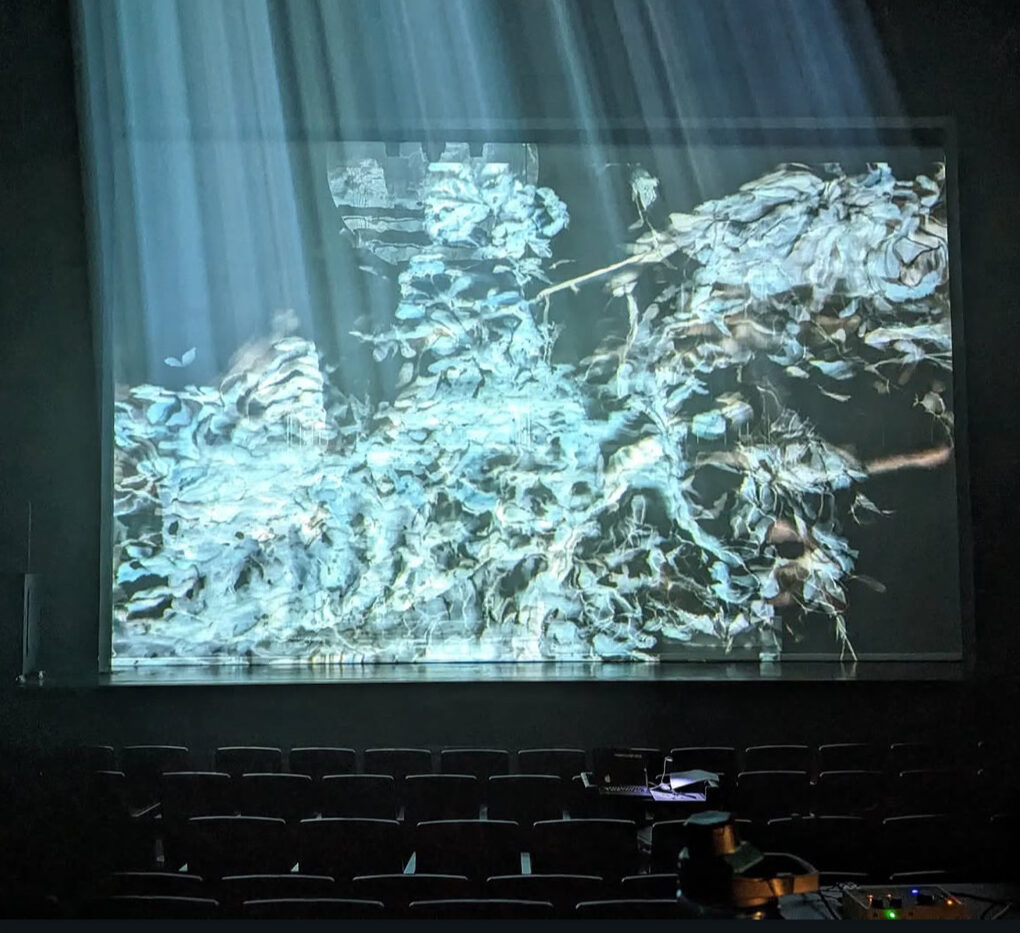
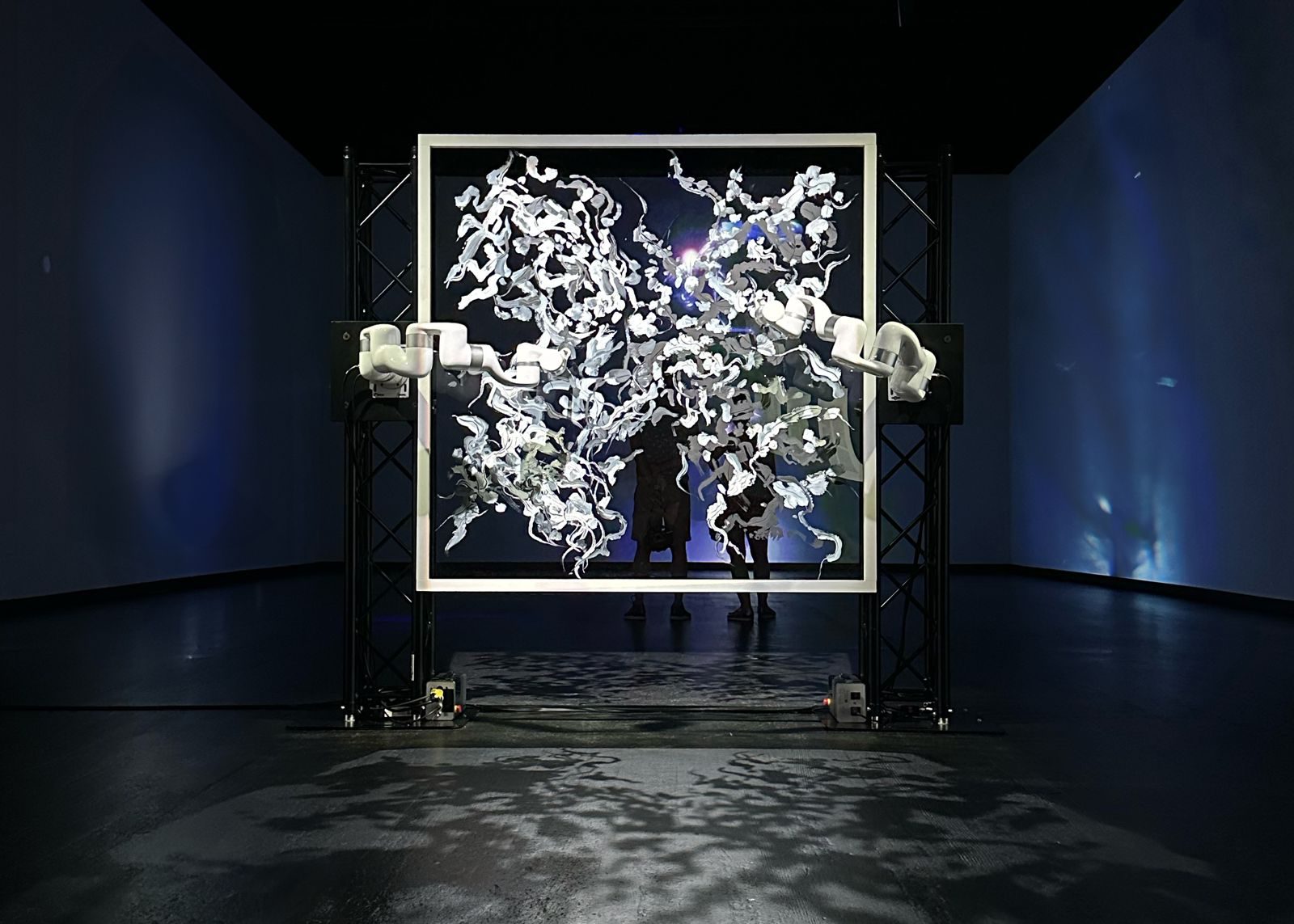
The scroll is accompanied by stele R1314, a digital inscription derived from 1,314 selected drawings and biosignal sessions from which the RECURSIONS system is built. The painted marks are inverted and overlaid with drifting particles of EEG data. Brainwave activity, robotic coordinates, and gestural velocity are encoded in the notation of genomic transcript, a FASTA-format sequence scrolling vertically through the work. The total duration is 1,314 seconds (一三一四, a homophone for 一生一世: for a lifetime).
The Recursive Mark
by Sougwen Chung
Artist & Researcher
— I SYSTEM — II SEED — III STROKE — IV SILVER — V SCROLL — VI STELE —
SYSTEM
(Computation)
—
"To understand the machine, one has to go beyond the mechanistic understanding of the machine, and return to the organism, and to the question of recursivity."
— Yuk Hui, Recursivity and Contingency
RECURSIONS is a monumental scroll that holds collaborative marks between myself and a robotic system (part of the Drawing Operations series) that I've developed for more than a decade. The system draws from a neural network I trained on decades of my own artistic archives, as well as on artefacts produced across the past 10 years of human-machine co-aesthetics. As I paint, I wear a custom EEG sensor that captures my live brainwave activity; different waves modulate the model's gestural response. The result is a recursive loop: the network learns from my past gestures and generates new trajectories to which I respond, after which the network integrates the response, and so on. Each session produces a different configuration. Each painting holds the trace of a specific negotiation.
The word recursion, 遞迴 (dìhuí) in Chinese, means to pass forward in sequence and to circle back through movement. The term is pretty standard computational vocabulary but it belies a wider etymology beyond the sciences. For me, it is a reminder of the cyclical nature of artistic expression. That the work is a means to move forward. To circle back. To separate, and to return. In the work, I explore recursion as both a computational structure and a genealogical one.
In computation, a recursive function is one that calls itself: a self-referential definition that generates new data at each step. Unlike iteration, which is fixed, recursion is in principle infinite: a program that never terminates, a structure that endlessly contains and re-evaluates itself. A self within a system.
In calligraphy, recursion is the transmission of embodied knowledge. I am exploring the idea that through artistic lineage, by studying the past and engaging by repetition, we internalise a logic that passes through bodies, an inherited muscle memory. A logic of mark-making that eventually leaves its mark on the practitioner themselves.
SEED
(Genealogy)
—
"To write is not simply to record a thought, but to enact a historical consciousness through the physical gesture of the hands."
— Vilém Flusser, Gestures
One of my oldest known ancestors is Zhong Yao (鍾繇, 151–230 CE), credited as the first recognised master of standard Chinese calligraphy, 楷書 (kǎishū). He was known for formalising calligraphy script into a systematic practice. His structural innovation was the consistent use of the 頓 (dùn), a pause technique: a deliberate moment of pressure at the start or end of a stroke in which the brush presses down, holds, then lifts or redirects.
No original works by Zhong Yao survive. His calligraphic technique is known to me only through later copies, written by practitioners he taught more than a century after his death. In a sense, the artefacts of his foundational hand are present only through transmission, legible only through the bodies that carried them forward.


"The artefacts of his foundational hand are present only through transmission, legible only through the bodies that carried them forward."
I think about what this could mean for my own artistic intentions. In the RECURSIONS system, the EEG sensor captures an alpha wave threshold, the boundary between cognitive states where the robotic system decides to act or to wait. The 頓 (dùn) pause technique originated by my ancestor finds a conceptual counterpart in the system's own threshold pause, governed not by volitional motor action but by my brain's involuntary biosignal. It is my translation of a calligraphic invention that now extends through a neural network trained on my own movements and gesture data. A genealogical passing forward in sequence and circling back through operational movement.
STROKE
(Script)
—
"Though the rules of writing are established, the mind must be free to wander; when the brush stops, the intention continues."
— Sun Guoting (孫過庭), Treatise on Calligraphy (書譜, Shūpǔ, 687 CE)
There is a calligraphic principle that breath and stroke are one. That the brush moves with respiration; that the mark is an extension of the self. Even the four qualities of a stroke are named in the body's own vernacular: bone, flesh, sinew, blood (骨肉筋血), mapping structure, volume, tension, and flow to the physical. If calligraphy is a somatic discipline before it is a visual one, a practice rooted in the body's rhythms and not the mind's decisions, then it carries a second principle: that every stroke is irreversible. Calligraphic ink on substrate cannot be corrected, layered over, taken back. The mark demands total presence. A third principle is that space is as active as the mark itself. 留白 (liúbái): the white space in a composition holds a silence that gives the stroke its weight.
And a fourth: that one's moral, emotional, and physical state is visible in the stroke. That one is revealed through the brush. The self breaks through a specific configuration of material and time.
To me, these principles are provocations. Calligraphy is a practice that has transmitted itself through bodies that predate the written word. And through this transmission, these principles describe the conditions under which RECURSIONS operates.
The brush is filled with two chemically incompatible ink systems. A water-based calligraphic ink sinks into tightly woven primed linen, bonding with the fabric's weave. A custom ink composite I developed by combining 99.99% pure silver flake (3–5µm) in shellac-based bioresin with silk fibroin protein derived from Bombyx mori cocoons sits on the surface. This material investigation was a discovery. Where the two inks interact on the surface, the composite bio-resin silver pushes the water-based ink away, creating moments of separation within a single stroke, each asserting its own material logic. As the ink dried, I observed that the silver is directionally reflective: it appears and disappears as the viewer moves past the work. It catches light at one angle and vanishes at another.
SILVER
(Substrate)
—
"For information to exist, it must always be instantiated in a medium... This means that the materialities of embodiment matter."
— N. Katherine Hayles, How We Became Posthuman


"When a signal becomes a mark, a mark becomes part of a surface, a current that dissipates at the threshold."
At its highest concentration, the silver composite has conductive properties. However, as the metallic ink commingles with its calligraphic counterpart, this conductivity erodes. These material interactions enact the processual questions of authorship. The line operates as a trace that slows time; a circuit that dissolves into drawing, yet carries current. It is a literal mingling of signal and ground. When a signal becomes a mark, a mark becomes part of a surface, a current that dissipates at the threshold.
In RECURSIONS, the fourth principle is enacted. My brainwave activity modulates the machine's response in real time: the self revealed through the brush, through the system, through the silver that carries and relinquishes the signal.
SCROLL
(Space)
—
"In this space, time does not rush toward a conclusion; it lingers, it gathers, it spatializes itself as a landscape of duration."
— Byung-Chul Han, The Scent of Time
The scroll (RECURSION 0, ten metres of linen) is the seed from which the RECURSIONS works emanate. Its format speaks to continuity: the scroll is an unbroken surface that holds a duration made spatial and embodied. That situates an embodied mark-making practice that accumulates without hierarchy.
A single, layered surface in which both are present. The performance of painting alongside the robotic system in real-time, is an enactment of the configuration itself: embodied labour, enduring mark, the recursive return to the site of drawing.
STELE
(Inscription)
—
"Biomedia does not represent the body; it compiles it. It operates on the premise that the biological and the digital are not separate domains, but two ways of articulating the same informatic code."
— Eugene Thacker, Biomedia

The scroll is accompanied by R1314, a digital work that holds what the canvas cannot.
R1314 is derived from 1,314 selected drawings and biosignal sessions from which the RECURSIONS system is built. In it, the figure of the scroll becomes ground: the marks are inverted, and the system underlying the work is revealed as trails of light and time, particles derived from my EEG data drifting over the gestural trace like sediment suspended in atmosphere. The effect is less a diagram than a weather system, the attentional field rendered as environment.
Within R1314, the brainwave activity, robotic coordinates, and gestural velocity are encoded in the notation of a genomic transcript, a FASTA-format sequence scrolling vertically through the work. By formatting the data of our collaboration as a biological sequence, the digital stele closes the genealogical loop established by the physical scroll. The human-machine drawing operation is reframed within the language of biological inheritance: a system that generates, through recursion, a digital record of its own becoming.
The total duration is 1,314 seconds. 一三一四 is a homophone for 一生一世: for a lifetime. The phrase reframes the temporal horizon of the work, the slow accretion of a shared practice sustained across years, across generations of hardware and cognition, across the changing conditions of the body, attention, and inheritance.
What does it mean to be a good ancestor? What generational memory is carried in the body?
A system that carries the archive; a seed that survives through transmission;
a stroke as a radical extension of the body; silver that conducts as it dissolves;
a scroll to hold space; a stele that inscribes a signal.
The recursion does not terminate.
It passes forward and
circles back. A story within a story,
a self within a system —
- Sougwen Chung
2026
SOUGWEN CHUNG: DRAWING OPERATIONS UNIT: GENERATIONAL TIMELINE
Generation 1
MIMICRY ⇢
2014 - 2016
Colour Tracking
Simultaneous, Mimicry
Immediate
Site Specific
4 axis Robotic Arm
Camera
Jitter,
Max MSP
Generation 2
MEMORY ⇢
2016 - 2018
Infra Red
Input / Output, Memory
Data Archives
Site Non-Specific
4 axis Robotic Arm
Camera,
Custom Software
Recurrent Neural Network
Python, Javascript, C++
Generation 3
COLLECTIVITY ⇢
2018 - Ongoing
Optical Flow
Multi-agent
Site Interpretive
New York City
Swarm Robotics
C++, Custom Robotic
Modelling, Fabrication,
Optical Flow, Custom
Global / Local
Positioning Software
Generation 4
SPECTRALITY ⇢
2020 - Ongoing
Form Tracking
Electro-physiological. EEG
Bio Interpretive
Basel / London
6 axis Robotic Arm
Python, Custom End Effector,
Custom Software,
Biometric Headset
Generation 5
ASSEMBLY ⇢
2022-Ongoing
Multi-Form Tracking
Electro-physiological. EEG
Multi-Positional
London / Helsinki
Multi-Robotic System
20 Year Training Data-driven Model, Bio-feeback Integration, Spatial Kinematics
Generation 6
RECURSIONS ⇢
2026
Gesture, Machine Motion
頓 (dùn) — the calligraphic pause EEG alpha-wave threshold
Hong Kong
D.O.U.G. — paired configuration Three decades of archived gesture / Neural network
頓-gated stroke, closed loop Movement as material
2.1 × 10m scroll — 1,314 seconds
— Operational Art —
drawing with robotics and living systems, since 2015
UPCOMING
2026 — MEMORY, Why We Make, Victoria and Albert Museum, London, UK; Opening April 18
2026 — Body Machine (Meridians), Palazzo Citterio, Brera, Milan, IT; Opening April 23
2026 — Talk, Tecnológico de Monterrey (EAAD), Online, April 28
2026 — STRANGE RULES, Performance Lecture, Berggruen Institute, Venice Biennale, IT; May 3–7
2026 — BODY MACHINE (MERIDIANS), Reworld at Atatürk Cultural Center (AKM), Istanbul, TR; June 3–7
2027 — R.O.S.
Monograph: Order Ecologies of Becoming Book ⇢
CV: Available upon request ⇢
RECENT
Exhibition — RECURSIONS, Solo w Fellowship / ArtxCode, Art Basel Hong Kong, CN ⇢
Talk — The Algorithmic State: In conversation with Guggenheim curator Noam Segal, School of Visual Arts, NY ⇢
Press — Zero 10’s Asian debut brings technology-forward art to a switched-on region Art Basel, HK ⇢
Video — Convo with Hans Ulrich Obrist: World Economic Forum, CH ⇢
Keynote — Embodied Collaboration: Guggenheim x Stonybrook, US ⇢
Screening — D.O.U.G._1-5 Film at Futurological Congress, Norway ⇢
Exhibition — Ecologies of Becoming (Solo) - Kunstverein Heilbronn, DE
Exhibition — Body Machine (Meridians) - Solo - East Slovak Gallery, SK
Exhibition — Promptoscape - Mingsheng Shanghai Museum, CN
PRESS
Sougwen Chung: Poetics of Human-Machine Interaction - Hube Mag ⇢
Meet the Boundary-pushing pioneer of robot art - The Art Newspaper ⇢
Materials of Contradiction - Interview in Sursurma Magazine ⇢
Podcast: Drawing with Robots - Atlantic Podcast ⇢
Artists Shaping Technology - Art Basel ⇢
© 2026 Sougwen Chung / SCILICET.
Operational Art
drawing with robotics and living systems, since 2015
For acquisition, commissioning, & press: ⇢office@scilicet.xyz
© 2025 Sougwen Chung / SCILICET.
embodied collaboration; metamorphic ecologies.
For press and collaborations: ⇢office@scilicet.xyz
© 2025 Sougwen Chung / SCILICET.
embodied collaboration; metamorphic ecologies. For press and collaborations: ⇢office@scilicet.xyz
© 2025 Sougwen Chung / SCILICET.
embodied collaboration; metamorphic ecologies.
For press and collaborations: ⇢office@scilicet.xyz
© 2025 Sougwen Chung / SCILICET.
embodied collaboration;
metamorphic ecologies.
For press and collaborations: ⇢office@scilicet.xyz
Newsletter Sign-up